Author: Jamie Thomas
The Three Types of Key Influencers Hiding in Your Organisation
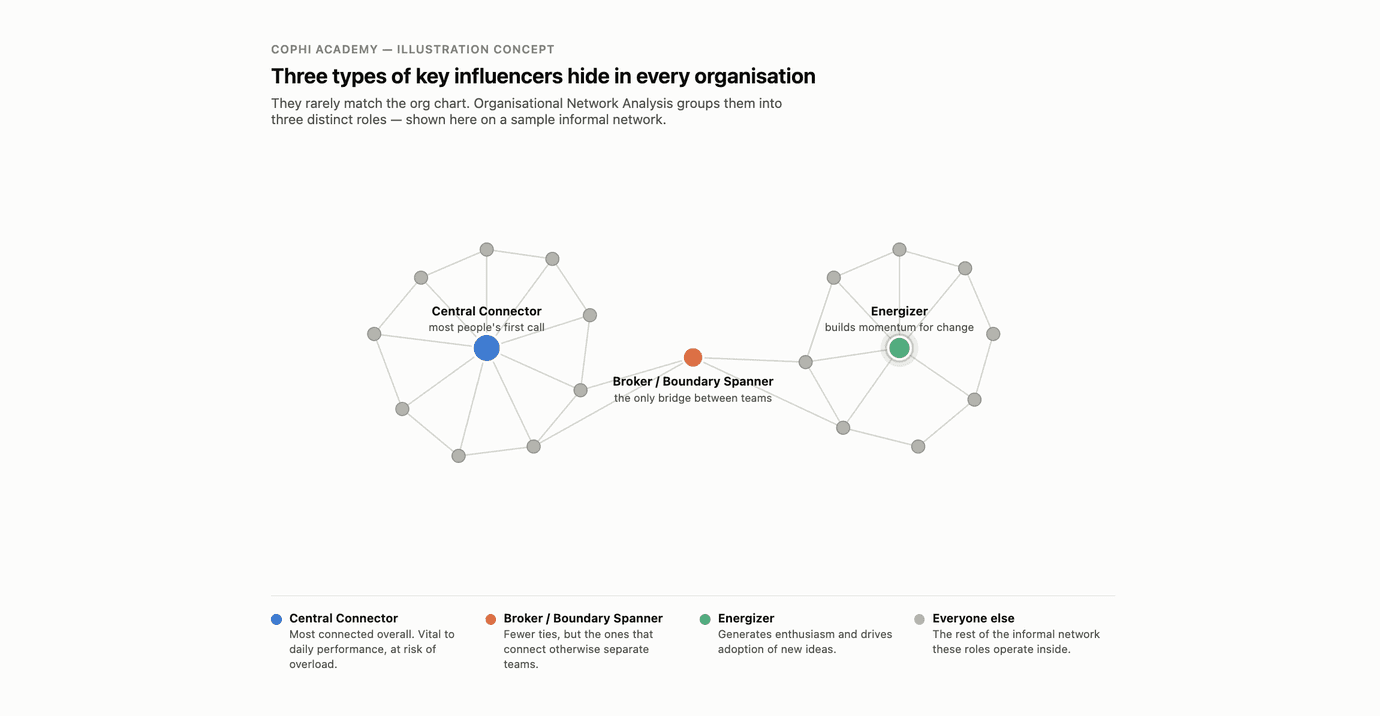
Every organisation has people who matter more than their job title suggests: the ones others go to for help, the ones who move information between teams no one else talks to, and the ones who get people genuinely excited about change.
Organisational Network Analysis (ONA) research, most notably from Rob Cross at Babson College, groups these people into three distinct roles. They're often lumped together as "key influencers," but they're not the same thing, and mixing them up is a common reason change efforts stall.
Central Connectors
The most-connected people in the informal network, the ones a large share of the organisation goes to directly. They're crucial to day-to-day performance, but because so much routes through them, they're also the most exposed to overload and burnout.
Brokers (or Boundary Spanners)
Fewer connections than a Central Connector, but the ones they have matter more: they bridge separate teams, departments, or functions that otherwise wouldn't talk to each other. They're the reason a good idea in one part of the business reaches another, and they're disproportionately important during mergers, reorganisations, and cross-functional programmes.
Energizers
Not defined by how many people they're connected to, but by the effect they have: they generate enthusiasm, build momentum behind new ideas, and make change feel possible rather than risky. A network can have strong Central Connectors and Brokers and still stall if there's no one energising it. (Worth flagging: this is the one role Cophi doesn't currently produce a dedicated ranked list for, it's included here for completeness and because "energizer"/"culture carrier" is a real search term, not because Cophi labels people this way today.)
Why leaders can't just guess
Cross's research found leaders can identify their organisation's Central Connectors only about half the time by instinct, and Brokers barely 30% of the time. These roles rarely map to seniority, which is exactly why they need to be measured rather than assumed.
Where Cophi fits
Cophi's Critical Connectors report identifies the best-networked individuals in an organisation using ONA survey data across multiple network dimensions, covering the Central Connector and Broker roles in a single ranked list, shared only with consent. You'll also see this concept called super-connectors, network brokers, hidden influencers, or bridge builders elsewhere; they're all pointing at the same underlying idea: influence that isn't visible on an org chart, but that your transformation, culture change, or M&A integration will succeed or fail on.
SHARE