Author: Jamie Thomas
Your Org Redesign Looks Right on Paper But Does the Network Agree?
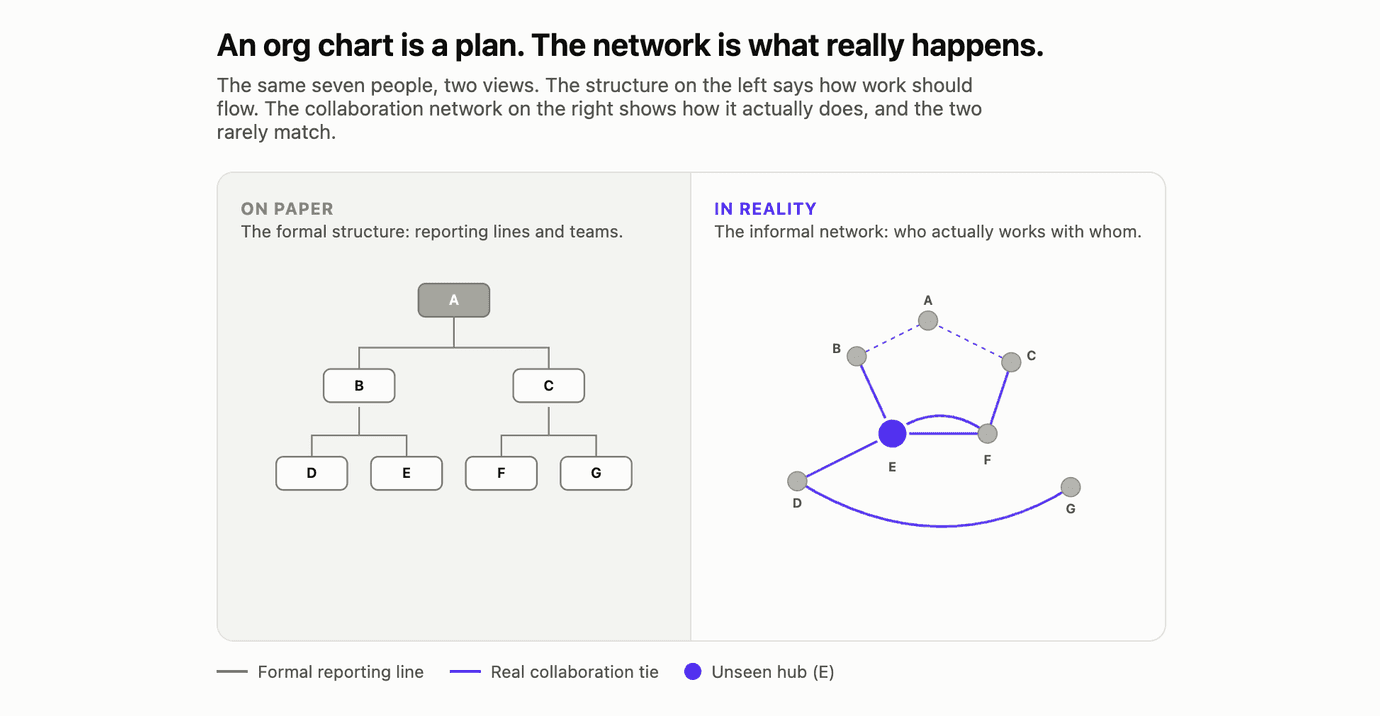
Most organisational redesigns are judged before anyone knows whether they work. A new structure is drawn up, the boxes and reporting lines are rearranged to fit the strategy, the slides are approved, and the change is rolled out. The design looks right on paper. Whether it actually improves how work gets done is left to hope and anecdote.
The trouble is that an org chart only describes the formal organisation: who reports to whom, and which team owns what. It says nothing about the informal organisation, the real web of who people go to for information, who solves problems across boundaries, and where collaboration is strong or quietly broken. And it is the informal organisation that determines whether a redesign delivers.
Structure is a hypothesis. The network is the result.
When you redesign an organisation, you are really making a bet: that changing the structure will change how people work together. Merge these two functions and they will collaborate more. Split that team out and it will move faster. Add a layer here and decisions will improve.
Those are reasonable hypotheses. But they are still hypotheses, and most organisations never test them. They assume that because the new structure looks better, collaboration must have improved. Often it hasn't. Sometimes the redesign severs a connection that was doing quiet, essential work, and no one notices until performance dips months later.
The organisation that keeps running underneath
The most common outcome of a redesign is not the new structure, and not the old one. It is both, running at the same time.
Reporting lines change overnight. Working relationships do not. When someone needs something done they go to the person who has delivered for them before, not to the person the new chart says owns it. That is rarely resistance and it is almost never deliberate. It is efficiency: a relationship that already works is faster than one that has to be built from nothing.
So the organisation runs in two versions. The new structure holds the accountability and the old one keeps much of the traffic. A manager who now owns a function finds that requests are still arriving somewhere else, and the colleague who no longer owns it finds they are still answering them. The people holding the two versions together are usually the same connectors who held the old organisation together, and they are rarely visible on either chart.
None of this shows on the org chart, which records only the new shape. None of it shows in an engagement survey, which asks how people feel rather than who they work with. It shows in the network, because the network records where the work actually went.
Organisational Network Analysis, the method behind Cophi, is how you test the bet. It measures the informal network directly, through a short survey rather than guesswork, and turns it into evidence you can actually look at: where collaboration is genuinely strong, where teams that are meant to work together don't, and which connections a structural change would put at risk.
Three moments where the network should have a vote
Before you redesign. Baseline how work actually flows today. A redesign built on the real network, rather than on assumptions about it, starts from a much better place. You can see which collaborations are load-bearing and must be protected, and which silos the new structure needs to close.
During a reorganisation or merger. This is where formal and informal diverge most violently. Reporting lines change overnight; relationships and trust do not. ONA shows where the two integrating organisations are actually connecting and where they are still operating as separate worlds, so integration effort goes where it is needed instead of where the chart says it should be fine.
After the change lands. This is the step almost everyone skips. Re-measure the network and you can answer the only question that matters, which is whether the redesign improved collaboration or simply rearranged it. Cophi's Net Collaboration Score (NCS) gives you a single before-and-after number to hold the change accountable to, alongside the detail of what moved and what didn't.
Cophi's role: evidence, not the redesign
To be clear about the limits: Cophi does not draw your new operating model or tell you how many layers to have. That is the work of your leaders and your design partners. What it provides is the missing evidence layer around that work, the empirical picture of how your organisation actually collaborates, so structural decisions are made with data rather than on faith, and so their impact can be measured once they are made.
An org chart is a plan. The network is what really happens. Before you commit to a redesign, it is worth asking whether the network agrees.
SHARE